🎯 Learning Objectives
- Calculate how many bits are required to represent sound (and the trade-offs involved)
- Use a sound editing program to apply what you have learnt and experiment with sounds
📝 Starter Activity – Terminology: what are the missing words?
To represent sound in digital form, regular measurements are taken, called , and a sequence of bits is recorded for each one of them.
The number of measurements taken per second is called the .
The number of binary digits recorded for each measurement is called the .
Hint: Here are the keywords from the previous lesson, in no particular order:
sample size, sampling rate, sample
📖 How many bits are required to represent a piece of sound?
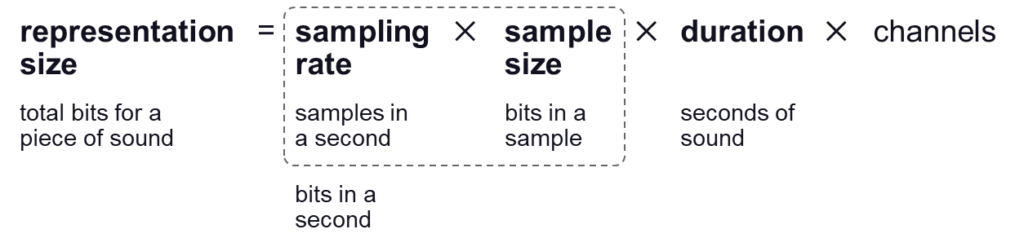
🥇 Level 1 – Representation size
Download the worksheet below to compute the size of audio files. Upload the completed activity to Teams.
📖 Sound representation: trade-offs

🥈 Level 2 – Sound Editing
Download the two worksheets below to start editing sounds. You need to complete both activities and upload the sound files you create to Teams.
Sound Files for Level 2 & 3
🥉 Level 3 – Sound Editing Challenges
Download the worksheet below to try some sound editing challenges. You need to complete at least 3 to get the level.
🥉 Level Up
🥇 Level 1
- Upload your completed Level 1 – Representation size Word file to the Teams assignment.
🥈 Level 2
- Upload your completed Level 2 – Sound Editing sound files to the Teams assignment.
🥉 Level 3
- Upload your completed Level 3 – Sound Editing Challenges sound files to the Teams assignment.
In this lesson, you…
- Calculated how many bits are required to represent sound
- Used a sound editing program to apply what you learnt and experiment with sounds!
Next lesson, you will…
- Take a quiz that will allow you to assess what you’ve learnt
- Describe alternative ways of representing images and sound
- Define what compression is and why it is necessary