🎯 Learning Objectives
- develop an understanding of how we can test for computer intelligence
- develop an understanding of what a CAPTCHA is and how to reverse it
- develop some understanding of the consequences of human-like AI
💬 Key Vocabulary
- artificial intelligence (AI)
- intelligence
- technology
- machine learning
- Turing test
- CAPTCHA
📖 Starter Activity – How could we test for intelligence?
- How can we tell if a computer is intelligent or not?
- What kind of questions would you ask it?
- Would the test be virtual or physical?
- Would you ask it to move, speak, think?
- Discuss in pairs and be ready to share your ideas with the class.
📖 The History of AI
- Although people have long thought about the possibility of Machines that could think, the science of AI really started with Alan Turing, back in the 1950s.
- Turing had devised a hypothetical machine called The Turing Machine, that was capable of performing extremely complicated computations.
- Turing devised a party game, called The Imitation Game. In the game, a man (A) and woman (B) would each go off to separate rooms. They could then communicate with the guests at the party, but only through typed messages. The man and woman would try to convince the guests that they were the other.
- The game was invented only to introduce the second more interesting version.
We now ask the question, “What will happen when a machine takes the part of A in this game?” Will the interrogator decide wrongly as often when the game is played like this as he does when the game is played between a man and a woman? These questions replace our original, “Can machines think?”The Imitation Game, Alan Turing, Mind, Volume LIX, Issue 236, October 1950, Pages 433–460, https://doi.org/10.1093/mind/LIX.236.433
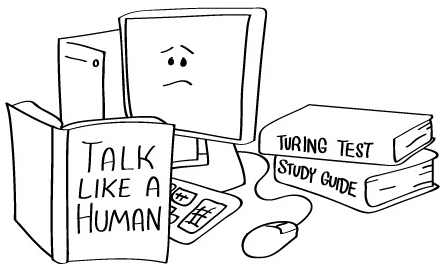
- Turing was arguing, that if a machine can convincingly trick a questioner into thinking it was a human, then it can be classified as intelligent. Or more philosophically – what is the difference between a human and a computer that is indistinguishable from a human?
- Let’s see how a Turing Test is actually done.
🥇 Level 1
- Open ELIZA in a new tab and have a chat with her.
- She was originally designed as a therapist.
- In 1966, Joseph Weizenbaum created ELIZA, that appeared to pass the Turing test.
- Weizenbaum’s program was able to fool some people into believing that they were talking to a real person, with some subjects being “very hard to convince that ELIZA was not human.
- Another more modern example would be Microsoft Copilot. This is Microsoft’s Large Language Model (LLM) chat AI, similar to ChatGPT and Google Gemini.
- You can use it by clicking this link: https://copilot.microsoft.com/
- Try talking to it to see what its responses are like, does it seem to be as smart as a real person?
- Write up your opinions on ELIZA and Copilot.
- Do you think either of them passes the Turing Test? Explain your reasons.
- Can you figure out the rules that dictate ELIZA’s responses? Write down the rules you have worked out.
📖 Learn It – Reversing the Turing Test

- Reversing The Turing Test has become a focus for research over the past few years.
- This means inventing a test that only a human can pass, and computers will always fail.
- The most common form of reverse test, of which you will probably be familiar is CAPTCHA.

- The idea behind CAPTCHA is to present to the user an image that a computer would not be able to understand.
- Without CAPTCHA it would be trivial to design a bot that could register a billion different online email addresses that could be used to send spam, for instance.
🥈 Level 2
- Have you ever seen the “I’m not a robot” checkbox when you’ve logged in or signed up for something on the web?
- These boxes are called CAPTCHAs and they are designed to stop AI from creating accounts and spamming the web. But how do they work?
- Watch the video below and then read the two articles to find out and then you will write a summary of how they work for the level 2 task.
- There is now an interesting battle between bots and CAPTCHA programs.
- In fact, Google have been using CAPTCHA to train their AIs.
- Read this article to learn a little more.
- Ironically, these AIs that are trained are then capable of solving Google’s own CAPTCHA which defeats the purpose of CAPTCHA.
- Read this article to learn a little more.
- Summarise your learnings from the above two articles and the video by focusing on the evolutions of CAPTCHA to identify humans from ever more advanced bots.
🥉 Level 3
Write a 200 word essay, using this article as a starting point, and using good English and examples or scenarios on the following points:
- The article says computers are faster at calculations than humans. In cybersecurity, how could this speed be used to help protect our information from hackers? Can you think of an example?
- If AI becomes super intelligent, could it potentially create new types of cyberattacks that humans haven’t even thought of yet? Why or why not?
- Do you think it would be a good idea to have AI completely in charge of cybersecurity in the future, or should humans always be involved? Explain your reasoning.
In this lesson, you…
- Compared chat-bots and decided whether they pass the “Turing Test“.
- Found out what machine learning is and how it is transforming our lives.
- Wrote about the consequences of AI being able to imitate humans.
Next lesson, you will…
- Work in a group to research and present information on a current use or development of AI.